
Bexar County Directory Holdings
San Antonio is the key city for Bexar County historical directories, but no one repository supplies a perfect run. The shelves at San Antonio Public Library, Texas State Library and Archives Commission, the Conservation Society, and university repositories overlap in useful ways. Start with the year needed, then choose the source that offers that edition. A citation should retain the city, publisher when shown, publication year, repository, and page. That makes a later comparison possible when a listing changes or a different copy contains a clearer page.
| Collection | Years | Where Held | Access |
|---|---|---|---|
| San Antonio directory volumes | 1877-present in the library description, not every year | SAPL Texana/Genealogy | Reference-only; readers and interim service apply |
| TSLAC San Antonio run | 1879-80 through 1993, with gaps | TSLAC reference room, Austin | Onsite print and microform |
| Conservation Society directories | 1877-2002, not every year | Conservation Society Library | Contact the library; much pre-1970 material is microfilm |
| UNT city-directory collection | Nineteenth and twentieth centuries | UNT Portal to Texas History | Digitized searchable images and indexes where supplied |
These ranges describe collection coverage, not a promise that each year survives or has been digitized. The TSLAC sequence has gaps, while the Conservation Society catalog is incomplete. A missing catalog hit can mean a call or reference request is the next research step, not that the volume never existed.
Note: Record the edition and repository before comparing an entry, because directory dates and catalog coverage are not evidence of continuous residence.
Bexar County Historical Reference Desk
SAPL Texana/Genealogy is the local starting shelf for San Antonio directories, newspaper microfilm, maps, clipping files, periodicals, and public access to Ancestry Library Edition. The collection is at SAPL Central, 600 Soledad. Materials are reference-only, and maps, clippings, and microfilm may not appear fully in the online catalog. The collection page describes interim service during the sixth-floor renovation, so confirm access with the library before making a special trip.
The SAPL service view below shows the collection source used for Bexar County directory research.

Use the reference desk to locate a needed volume, reel, clipping file, or map before assuming a keyword search has exhausted the local collection. The published contact number is 210-207-2559.
For a rural Bexar County address, ask about the Bexar County Rural Directory. Its second section covers roads, house numbers, and rural routes, making it a useful bridge where a modern San Antonio street search does not fit the historical address.
Reading a Bexar County Directory
A directory entry is a printed snapshot made under a particular publisher's rules. The inspected UT Briscoe example visibly combines a personal name with a business or agency line and a page image. Other volumes can present an address, telephone information, a household marker, a boarding notation, or an affiliation. Do not expand a mark from memory. Worley's, Polk's, and other publishers used different conventions, so the explanatory pages at the front of the same volume control the reading of its symbols.
| Name as printed | Keep initials, suffixes, spelling, and punctuation as the edition shows them. |
|---|---|
| Address or business line | Transcribe the number and street exactly, and label any non-home line as printed. |
| Telephone or role notation | Use only a field visible in that volume; formats and abbreviations vary by publisher. |
| Page and edition | These let another reader return to the same image instead of relying on a search snippet. |
- Criss-cross directory
- The address-order portion of a directory, used to look from street and number toward the dated listing or business notation.
- Householder index
- An index organized around a named household entry rather than a claim that every person at the address appears.
- Abbreviation key
- The publisher's explanatory pages, usually near the front, that define the marks used in that edition.
Exact spouse and owner symbols were not visible in the inspected Briscoe excerpt. That gap is a reason to cite the printed key, not a reason to supply a confident expansion.
Bexar County Digital Directory Runs
The UNT Portal to Texas History collection is the strongest online starting point for a distant search. It describes nineteenth- and twentieth-century city, business, legal, and telephone directories, with 361 items across 16 counties. Search by city, surname, street, and year when the repository supplies those paths, then preserve the page image in the citation rather than relying on a result snippet.
The UNT collection view below is a digitized source for Bexar County city directory research.
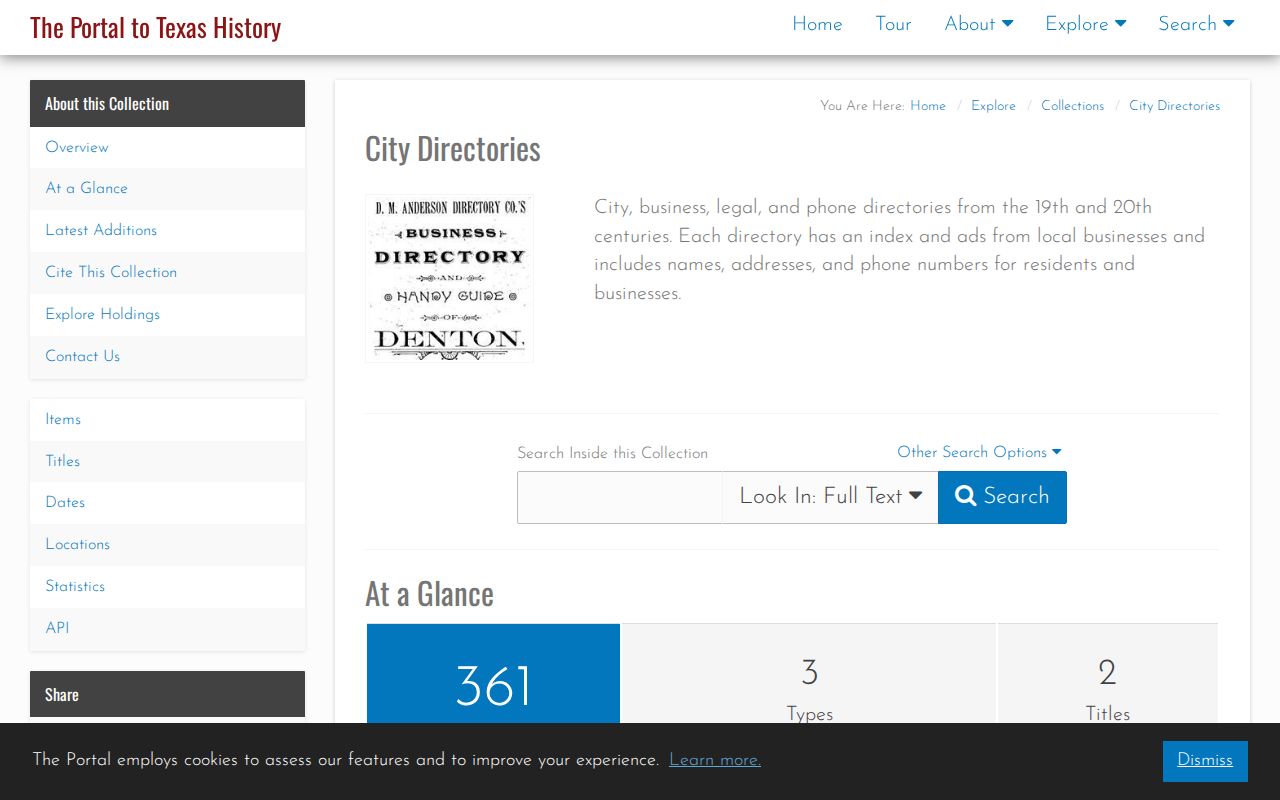
UNT does not replace the physical shelf. Its online material is a useful first pass, while SAPL, TSLAC, and the Conservation Society may hold the needed year in another format. The UT Briscoe Center's Bexar County Library collection supplies selected digitized Worley and Polk material and is another page-image source. FamilySearch lists selected Worley volumes on film, but catalog and center access varies.
Bexar County Directory Dates
The local directory era begins by 1877 in the SAPL and Conservation Society descriptions. TSLAC's San Antonio run starts at 1879-80 and continues through 1993 with gaps, while SAPL describes a run to the present. The research did not locate a definitive final printed year. Treat each date as a collection statement and check the live catalog or staff for an exact edition.
| 1877 | SAPL and the Conservation Society describe the beginning of the local directory era. |
|---|---|
| 1879-80 | TSLAC's surviving San Antonio sequence begins, with several early years on film. |
| 1993 | TSLAC's listed run reaches this year, but it includes gaps and does not establish a last printed volume. |
TSLAC's San Antonio directory listing documents the dates and its access limit. The service is print and microform at the Austin reference room. Staff do not search, scan, or email an entry by telephone.
The TSLAC listing below is the source for the onsite-only access warning and the dated run.
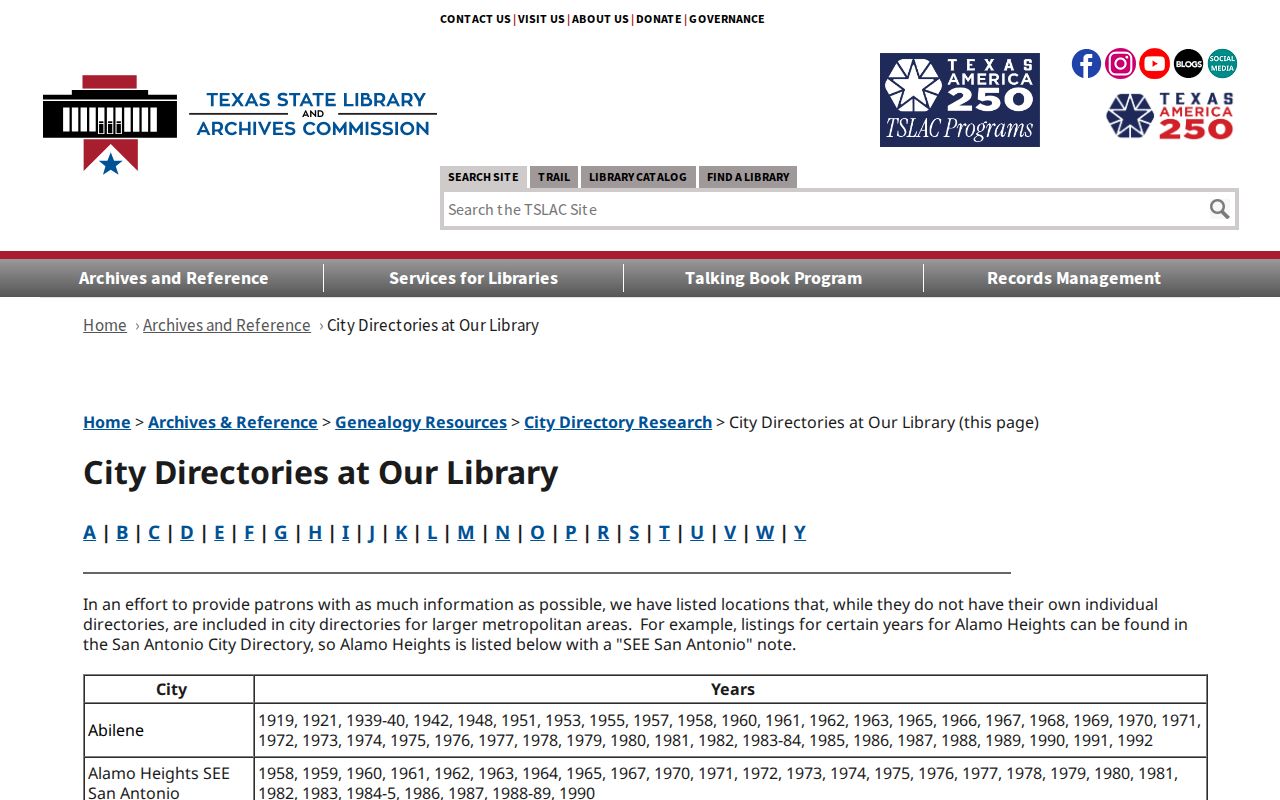
When an edition is absent, note the gap and check another repository rather than quietly substituting a nearby year. A nearby volume can support a comparison, but it is still a different dated source.
Tracing Bexar County Directory Households
Use a directory run as a sequence of dated observations. Begin with the closest known listing, then read the edition before it and the edition after it. Pair the directory dates with the released federal census years, where the census can supply a household and geographic snapshot. A name that appears once is a single-year listing. A name that appears across several editions still does not prove uninterrupted residence between publication dates.
- Transcribe the name, address, publisher, year, and page exactly from the first Bexar County directory entry.
- Check the adjacent editions for the same spelling, a moved address, a changed business line, or a missing listing.
- Read the edition's criss-cross portion when available, then keep its household or business notation separate from a deed role.
- Pair the surrounding directory editions with the appropriate released census year and label each source by its own date.
- Use newspapers, probate, cemetery material, maps, or a permit only as a separate corroborating record with its own date and purpose.
For a present-day, address-keyed record chain, the Bexar County street directory has the current parcel and deed approach. Historical directories remain most useful when the question is what an edition printed, not who is at an address today.
Bexar County Directory Address Crosswalks
Old numbers and street names need their own evidence trail. Transcribe the historical address exactly, search the preceding and following directory volumes, locate the relevant Sanborn sheet, and compare the deed or plat legal description. San Antonio's addressing authority or municipal archive material can help when an old and current number are thought to match, but record a modern crosswalk only when the sources support it.
The Library of Congress has a public-domain October 1888 San Antonio Sanborn set of 16 sheets. Local holdings include specific years from 1885 through 1951 and a complete 1952 set at the Conservation Society. A sheet can show a street, block number, footprint, or building context for its map date. It is not a current boundary or a current directory of people.
Note: Cite the map city, edition, sheet, scale, and date, because a Sanborn label describes historical cartography rather than a current parcel fact.
Limits of Bexar County Listings
Directories can carry a move forward, omit a person, list a business office, or use an address that changed later. A cemetery item is a historical interment clue, not an address record. A map can show a building or street name, not a household roster. Dated evidence should be labeled with the kind of record and the printed or recorded date instead of being combined into a stronger claim.
The Conservation Society at 1146 S. Alamo holds directories, maps, clippings, Sanborn material, and Bexar County tax-roll microfilm. Its catalog is incomplete, so a direct inquiry may locate a relevant unlisted item. That is a catalog fallback, not proof that an unlisted record contains a particular name.
Citing a Bexar County Directory
A useful citation names the repository, collection, city, publisher if printed, edition year, page, and image or reel identifier. State what the source shows with a date-bound phrase such as “listed at this address in the 1948 directory.” Use separate labels for a directory listing, deed party, permit contact, parcel owner label, or map context. Each is a different kind of evidence.
If the needed volume is not online, use the library, historical society, TSLAC reference room, or a FamilySearch catalog inquiry. Keep a note of the catalog search, missing year, and access limit. That preserves the distinction between “not located in the searched index” and a claim that no record exists.