
Finding Bexar County Residents
A Bexar County residents search works best when it starts with a precise question. For a current property connection, use an address or owner label in the appraisal and parcel records. For a recorded transaction, search the County Clerk index by party, document type, subdivision, or recorded date. A dated registration can be checked through the elections application when its required details are available. Historical questions call for a directory edition, a map, an archive item, or a deed book. Each source records a different relationship to a place, not a complete list of everyone in a household.
Keep the source date and identifier with each result. A parcel value, a voter registration, a deed party, and a directory listing all answer different questions. Two independent anchors, such as the same name and address in a dated directory and deed record, make a stronger match than a surname alone. When a result is missing, describe it as not located in that searched index, then try the custodian or an archive rather than assuming the record does not exist.
- Start with the exact name, address, or time period already known.
- Check the parcel or appraisal record for a property identifier and situs address.
- Search the Clerk index for a recorded instrument tied to that name or legal description.
- Use the voter application only for its individual, privacy-limited registration purpose.
- For an older household, compare city directory editions and archive sources, then request an existing non-exempt record when the online path ends.
Bexar County Resident Records Offices
Bexar County keeps its resident-related records in separate offices. The County Clerk records deeds, plats, liens, marriage licenses, probate material, assumed names, notices, and Commissioners Court records. BCAD maintains appraisal and property information, while the Elections Department manages registration and precinct services. The District Clerk holds district civil and felony matters, including divorce files. San Antonio adds municipal archive and permit routes. Knowing the office first prevents an address, an instrument, or a case number from being searched in the wrong system.
Bexar County Clerk Recordings
101 W. Nueva St., Suite 103
San Antonio, TX 78205
210-335-2273
Bexar County Elections
1103 S. Frio St., Suite 100
San Antonio, TX 78207
210-335-VOTE (8683)
Bexar County Deed Index Paths
The County Clerk’s official records portal is the strongest Bexar County residents directory route when a recorded land transaction is the starting point. Its department selector and search-term box support terms such as a grantor, grantee, subdivision, document type, or document number. A narrow recorded-date range is useful when a name is common. “Index Only” looks through indexed words. “Index & Full Text (OCR)” searches scanned text and can find a name in an instrument body, but OCR results still need to be read against the record image.
Save the instrument number, document type, recorded date, grantor, grantee, legal description, and image availability. The instrument number is more dependable than a browser result link. A deed party identifies a role in a transaction, not a promise that someone lives at the address now. For older material, the online index has no confirmed official start year, so the Clerk counter and Texas State Library and Archives Commission holdings are the fallback path.
See the Bexar Official Records Search before selecting a department or date range.
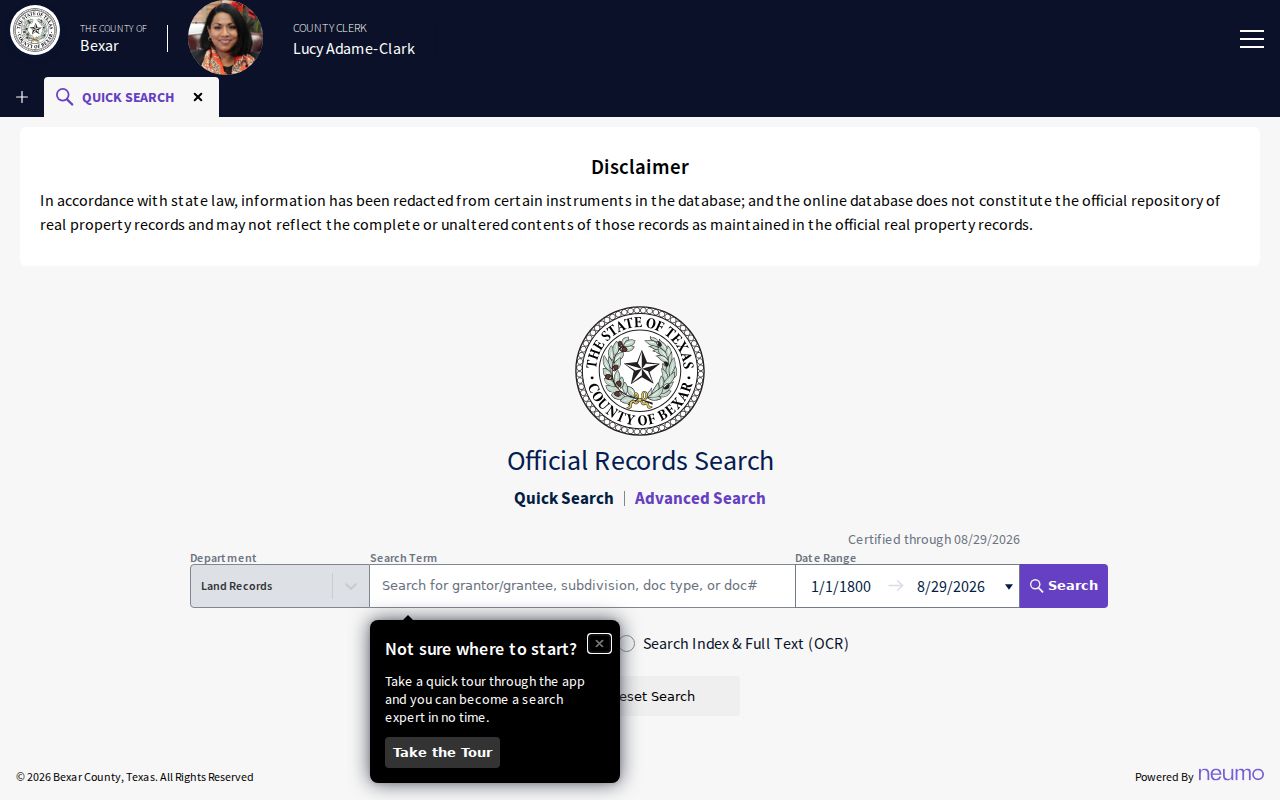
The recorded-date controls and department choices help separate a general name lead from a specific Bexar County instrument search.
Bexar County Voter Record Limits
Bexar County’s voter application is a narrow, individual lookup rather than a bulk resident roll. It asks for date of birth and house number before requesting a last name. A matching result can show a registered address, precinct, polling location, election information, and representatives. It can help test an already-supported match, but it should not be used to infer a complete household or physical presence on a particular day.
| Lookup control | Purpose |
|---|---|
| Date of birth | Required first-step match control, not a public display field. |
| House number | Required address narrowing control. |
| Voter’s last name | Required final match field. |
| Precinct and election links | Result information tied to registration geography. |
Open the Bexar County Voter Registration Search only when those controls are appropriate for a lawful, specific search.
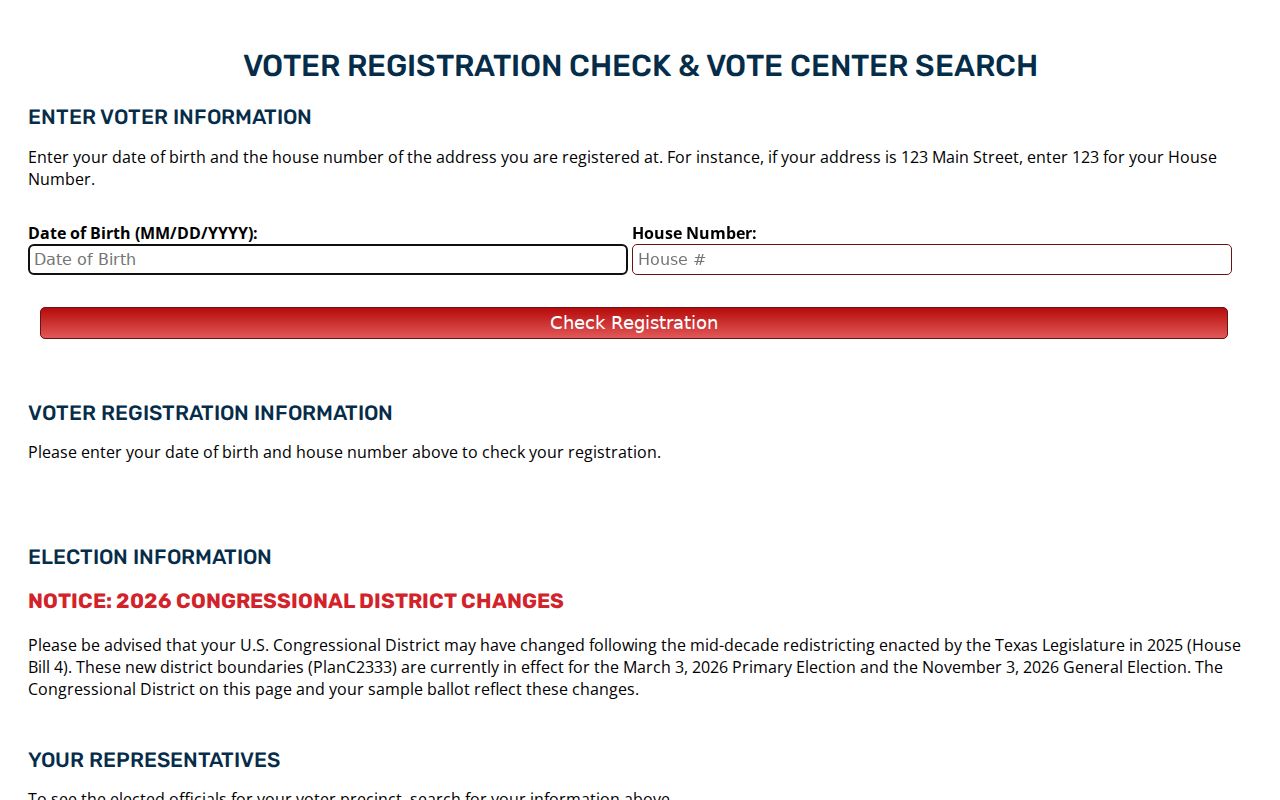
Texas Election Code Section 13.004 can suppress or substitute protected voter information, so no result or a partial result must not be used to reconstruct a hidden address.
Current Bexar County Resident Sources
There is no single current Bexar County residents directory. The useful public sources are record-specific. BCAD and the parcel layer identify a parcel and owner label. The Clerk index identifies parties to recorded instruments. The voter application is an individual registration lookup with strict controls. Court indexes identify parties and case events, not a complete personal history. Business and credential databases can establish an organization or license role, but an organization address is not automatically a home address.
| Source | Who It Lists | Keeper | Access |
|---|---|---|---|
| BCAD and parcel GIS | Parcel owner label, situs, legal description, and property fields | Bexar Appraisal District and County GIS | Online, counter, or public-information request |
| Voter registration search | Individual registered-name, address, and precinct match | Bexar County Elections | Required controls; protected records may be withheld |
| Official records index | Recorded deed, lien, plat, and notice parties | Bexar County Clerk | Free index; copy access varies |
| Court records | Case party, filing number, court, and dated event | County Clerk or District Clerk | Portal and clerk counter; confidential files excluded |
| Association registry | Registered organization contacts and boundaries | City of San Antonio | Voluntary registry, not a household roster |
A good Bexar County residents directory result labels what it supports. “Owner label,” “recorded party,” “registered address,” and “directory listing” are not interchangeable. When the goal is one person rather than a place, the Bexar County resident lookup path uses a two-anchor comparison instead of treating a name hit as a certainty.
| Official Bexar County source | Commercial search category |
|---|---|
| Identifies its custodian, record type, and date, with access rules set by that office. | May combine public indexes, directory material, licensed data, or user-submitted associations from different dates. |
| Lets a reader check the original parcel, instrument, filing, or registration context. | Can offer a lead, but same-name results, delayed updates, and mixed addresses require confirmation at the originating custodian. |
- Parcel
- A mapped unit of land with a property identifier and legal description.
- Index
- A finding tool that points to records; it is not always the underlying image or certified copy.
- Resident roll
- A source that records a person for a limited purpose and date, such as registration or a directory listing.
- Criss-cross directory
- The street-order part of some city directories, used to find a dated listing by address.
Bexar County Archive Collections
San Antonio’s Archive Search adds local records that do not live in the county systems. Advanced searching allows two search rows with field, condition, phrase, And/Or, start and end dates, media type, and a digital-collections choice. The named collections include city birth records from 1896 to 1936, death records from 1873 to 1926, city deeds from 1847 to 1929, tax maps from 1898 to 1990, engineer maps, council material, and elections. A search hit can lead to an image, a finding aid, or a physical series.
For material that is not digitized, the Office of the City Clerk and Municipal Archives is the proper follow-up. Research there is by appointment for some items. A city deed or archive map is dated local context, not proof of present residence. Pair it with the collection date and a current parcel or address check.
Texas Vital Records for Bexar Residents
Texas DSHS Vital Statistics manages statewide birth and death records and statewide marriage and divorce verifications. Bexar County Clerk services include local vital copies and certified marriage licenses, while certified divorce decrees come from the District Clerk. The products are not interchangeable. A verification can confirm an event without supplying the underlying county license or court decree.
Birth records are generally closed for 75 years and death records for 25 years. Closed-period access requires the qualifying relationship or direct tangible interest described by the custodian. The inspected DSHS pages identify digital birth index coverage beginning in 1925 and death index coverage beginning in 1965, with earlier microfiche beginning in 1903. An index entry is a research lead, not a certified copy or a current-address statement.
The Texas DSHS vital-record application forms show the state route and separate form choices.
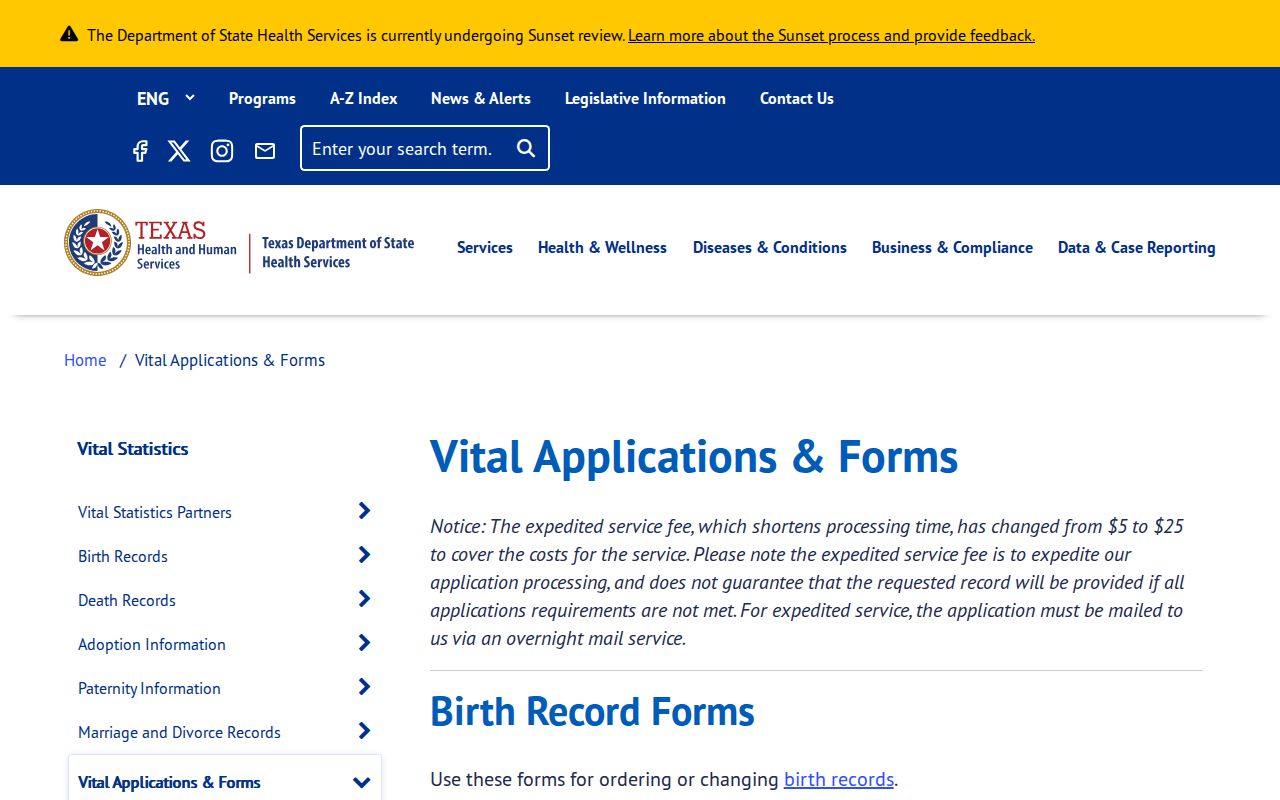
Use the official eligibility instructions before requesting a certified record, and use the County Clerk or District Clerk when the research calls for the local underlying document.
Bexar County Records Request Route
When a needed Bexar record is held by government but cannot be located in an online index, the Texas Public Information Act provides a written request route. Texas Government Code Chapter 552 applies to requests for existing records. It does not require an office to create a resident list, solve a research question, or release information made confidential by law. Identify the office, record series, address, parcel, instrument or case number, date range, and requested format.
Bexar County’s portal routes requests to the responsible department and allows tracking. San Antonio has a separate open-government request process for City-held material. Ask for the existing non-exempt index entry or image, not for an agency conclusion about who lives at an address. Fees, clarifications, volume, or legal review can affect timing, so retain the request date and response.
Use the Bexar County public-records request portal when the custodian confirms its department holds the material.
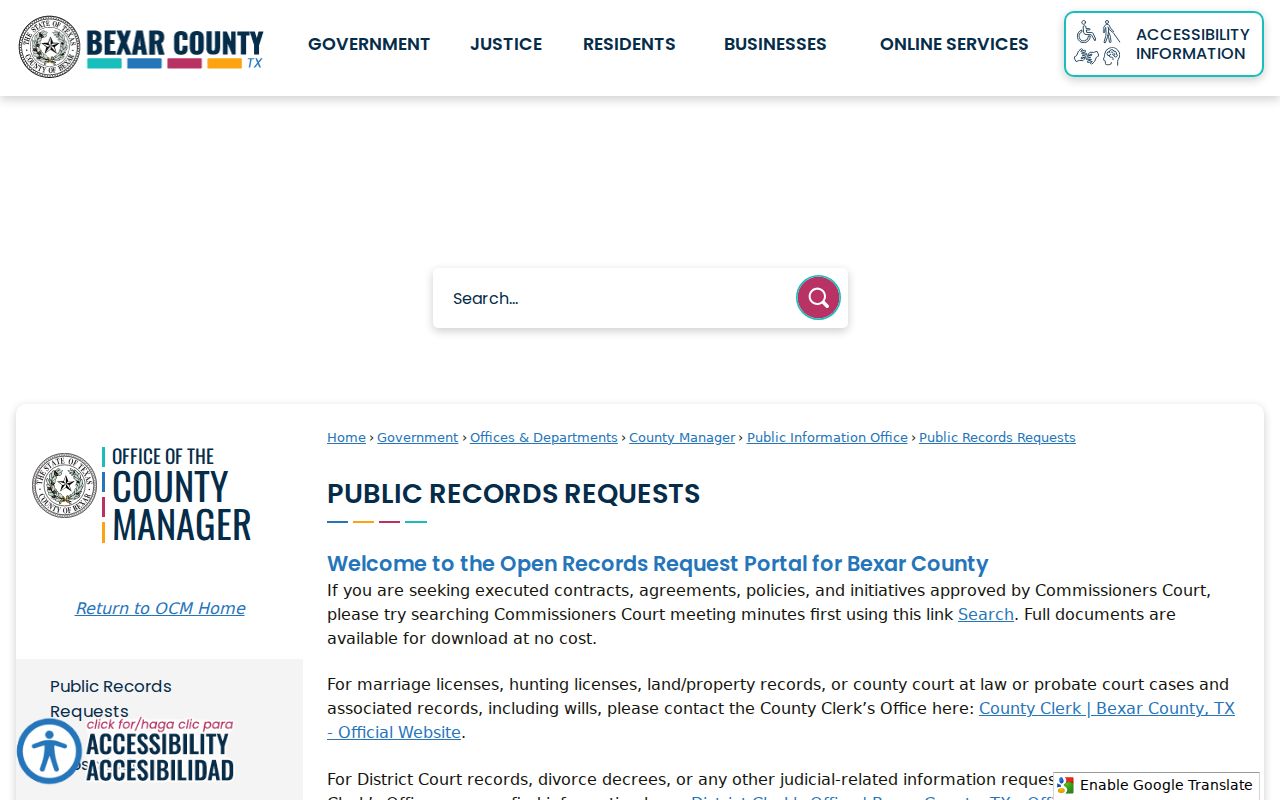
The portal is a fallback for existing county records that are not searchable online, not a substitute for the Clerk, BCAD, Elections, or archive search tools.
Historical Bexar County Resident Lists
San Antonio city directories are the key published resident lists for the Bexar County area. San Antonio Public Library describes a run from 1877 to the present, though no repository holds every edition. Texas State Library and Archives Commission lists a San Antonio run from 1879-80 through 1993 with gaps and early film-only access. The Conservation Society has city directories from 1877 to 2002, with many pre-1970 volumes on microfilm. UNT and UT Briscoe add digitized volumes and pages.
Directory entries are snapshots. They may show a name, street address, business or occupation, telephone, spouse notation, or a household role according to the publisher’s conventions. Cite the edition, page, and repository. The historical Bexar County city directory collections are the place to compare a full run and read its abbreviation key before drawing a conclusion from an entry.
Bexar County 1837 Archive Gaps
Bexar County’s record trail is older than its modern web portals. County government was formally organized in 1837, and TSLAC documents Bexar deed records from 1837 through 1889 with direct and reverse indexes. It also notes missing or unfilmed volumes. Those gaps are a concrete reason not to treat a no-result in a current portal as a final answer. Historic Commissioners Court minutes have a county-linked KoFile search for 1837 through 1965, while other material remains in microfilm, archives, or library collections.
For a nineteenth-century property question, record the index letter, volume, date range, and any noted gap before widening the search. City records offer a second historical path: Municipal Archives collections include San Fernando de Bexar minutes from 1770 through 1824, city deeds from 1847 through 1929, and engineer maps from the same period. Different historical boundaries and custodians can explain why one office has no matching record.
Note: An archive gap or unfilmed volume means the source path is incomplete, not that the person, parcel, or instrument never existed.
Bexar County Directory Dates
For a historical household, compare at least one directory before a key year, the closest available edition, and one after it. Sanborn maps can add the street, lot, building, and block context for the same period. SAPL’s local-history guidance also names Builder’s Exchange Service Bulletins from 1920 through 2009 as a source for construction, architect, builder, and developer context when a later permit search is silent.
The address itself may change. A Texas Historical Commission house-history example treats 505 Belknap as a former 605 Belknap and uses dated directory references to establish continuity. That is a useful local method: retain both numbers, the source year, a map or legal-description crosswalk, and the original printed form. Do not force an old number into a modern address field without supporting evidence.
Verify Bexar County Resident Matches
Verification is the last Bexar County residents directory step, not an afterthought. Compare full names, middle initials, suffixes, dates, parcel identifiers, case numbers, instrument numbers, and roles as printed. One source can be a possible match. Two independent anchors can support a probable match when they agree in time and place. A historical directory address and a deed legal description, for example, can be compared without calling either a present-day residence claim.
Use cautious verbs: listed, recorded, filed, displayed, or mapped. Parcel data can be stale, map geometry is approximate, directory editions are historical, and protected records may be withheld. A current owner label, a recorded deed party, and a registered voter address remain distinct evidence types. That care makes a Bexar County directory search more useful for family history, estate work, reconnecting, civic research, and checking a suspicious solicitation.